|

John Mackey is Chairman and CEO of Whole Foods Market, a $4 billion Fortune 500 company, and a "Fortune 100 Best Companies To Work For" every year since 1998. Whole Foods is one of the top 12 supermarket companies in America and the world's largest natural foods retail chain. John Mackey was named the Ernst and Young Entrepreneur Of The Year in 2003.
The following debate featuring John Mackey, Milton Friedman, and Cypress Semiconductor's T.J. Rodgers originally ran in Reason magazine, in October of 2005.
Thirty-five years ago, Milton Friedman wrote a famous article for The New York Times Magazine whose title aptly summed up its main point: “The Social Responsibility of Business Is to Increase Its Profits.” The future Nobel laureate in economics had no patience for capitalists who claimed that “business is not concerned ‘merely’ with profit but also with promoting desirable ‘social’ ends; that business has a ‘social conscience’ and takes seriously its responsibilities for providing em ployment, eliminating discrimination, avoid ing pollution and whatever else may be the catchwords of the contemporary crop of re formers.”
Friedman, now a senior research fellow at the Hoover Institution and the Paul Snowden Russell Distinguished Service Professor Emeritus of Economics at the University of Chicago, wrote that such people are “preach ing pure and unadulterated socialism. Busi nessmen who talk this way are unwitting pup pets of the intellectual forces that have been undermining the basis of a free society these past decades.”
John Mackey, the founder and CEO of Whole Foods, is one businessman who disagrees with Friedman. A self-described ardent libertarian whose conversation is peppered with references to Ludwig von Mises and Abraham Maslow, Austrian economics and astrology, Mackey believes Friedman’s view is too narrow a description of his and many other businesses’ activities. As important, he argues that Friedman’s take woefully undersells the humanitarian dimension of capitalism.
In the debate that follows, Mackey lays out his personal vision of the social responsibility of business. Friedman responds, as does T.J. Rodgers, the founder and CEO of Cypress Semiconductor and the chief spokesman of what might be called the tough love school of laissez faire. Dubbed “one of America’s toughest bosses” by Fortune, Rodgers argues that corporations add far more to society by maximizing “long-term shareholder value” than they do by donating time and money to charity.
Reason offers this exchange as the starting point of a discussion that should be intensely important to all devotees of free minds and free markets. Comments should be sent to .
Putting Customers Ahead of Investors
John Mackey
In 1970 Milton Friedman wrote that “there is one and only one social responsibility of business—to use its resources and engage in activities designed to increase its profits so long as it stays within the rules of the game, which is to say, engages in open and free competition without deception or fraud.” That’s the orthodox view among free market economists: that the only social responsibility a law-abiding business has is to maximize profits for the shareholders.
I strongly disagree. I’m a businessman and a free market libertarian, but I believe that the enlightened corporation should try to create value for all of its constituencies. From an investor’s perspective, the purpose of the business is to maximize profits. But that’s not the purpose for other stakeholders—for customers, employees, suppliers, and the community. Each of those groups will define the purpose of the business in terms of its own needs and desires, and each perspective is valid and legitimate.
My argument should not be mistaken for a hostility to profit. I believe I know something about creating shareholder value. When I co-founded Whole Foods Market 27 years ago, we began with $45,000 in capital; we only had $250,000 in sales our first year. During the last 12 months we had sales of more than $4.6 billion, net profits of more than $160 million, and a market capitalization over $8 billion.
But we have not achieved our tremendous increase in shareholder value by making shareholder value the primary purpose of our business. In my marriage, my wife’s happiness is an end in itself, not merely a means to my own happiness; love leads me to put my wife’s happiness first, but in doing so I also make myself happier. Similarly, the most successful businesses put the customer first, ahead of the investors. In the profit-centered business, customer happiness is merely a means to an end: maximizing profits. In the customer-centered business, customer happiness is an end in itself, and will be pursued with greater interest, passion, and empathy than the profit-centered business is capable of.
Not that we’re only concerned with customers. At Whole Foods, we measure our success by how much value we can create for all six of our most important stakeholders: customers, team members (employees), investors, vendors, communities, and the environment. Our philosophy is graphically represented in below:
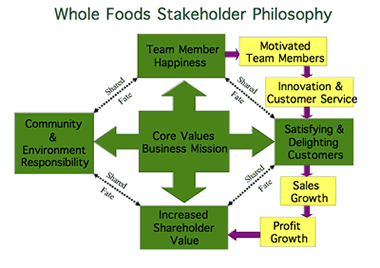
There is, of course, no magical formula to calculate how much value each stakeholder should receive from the company. It is a dynamic process that evolves with the competitive marketplace. No stakeholder remains satisfied for long. It is the function of company leadership to develop solutions that continually work for the common good.
Many thinking people will readily accept my arguments that caring about customers and employees is good business. But they might draw the line at believing a company has any responsibility to its community and environment. To donate time and capital to philanthropy, they will argue, is to steal from the investors. After all, the corporation’s assets legally belong to the investors, don’t they? Management has a fiduciary responsibility to maximize shareholder value; therefore, any activities that don’t maximize shareholder value are violations of this duty. If you feel altruism towards other people, you should exercise that altruism with your own money, not with the assets of a corporation that doesn’t belong to you.
This position sounds reasonable. A company’s assets do belong to the investors, and its management does have a duty to manage those assets responsibly. In my view, the argument is not wrong so much as it is too narrow.
First, there can be little doubt that a certain amount of corporate philanthropy is simply good business and works for the long-term benefit of the investors. For example: In addition to the many thousands of small donations each Whole Foods store makes each year, we also hold five 5% Days throughout the year. On those days, we donate 5 percent of a store’s total sales to a nonprofit organization. While our stores select worthwhile organizations to support, they also tend to focus on groups that have large membership lists, which are contacted and encouraged to shop our store that day to support the organization. This usually brings hundreds of new or lapsed customers into our stores, many of whom then become regular shoppers. So a 5% Day not only allows us to support worthwhile causes, but is an excellent marketing strategy that has benefited Whole Foods investors immensely.
That said, I believe such programs would be completely justifiable even if they produced no profits and no P.R. This is because I believe the entrepreneurs, not the current investors in a company’s stock, have the right and responsibility to define the purpose of the company. It is the entrepreneurs who create a company, who bring all the factors of production together and coordinate it into viable business. It is the entrepreneurs who set the company strategy and who negotiate the terms of trade with all of the voluntarily cooperating stakeholders—including the investors. At Whole Foods we “hired” our original investors. They didn’t hire us.
We first announced that we would donate 5 percent of the company’s net profits to philanthropy when we drafted our mission statement, back in 1985. Our policy has therefore been in place for over 20 years, and it predates our IPO by seven years. All seven of the private investors at the time we created the policy voted for it when they served on our board of directors. When we took in venture capital money back in 1989, none of the venture firms objected to the policy. In addition, in almost 14 years as a publicly traded company, almost no investors have ever raised objections to the policy. How can Whole Foods’ philanthropy be “theft” from the current investors if the original owners of the company unanimously approved the policy and all subsequent investors made their investments after the policy was in effect and well publicized?
The shareholders of a public company own their stock voluntarily. If they don’t agree with the philosophy of the business, they can always sell their investment, just as the customers and employees can exit their relationships with the company if they don’t like the terms of trade. If that is unacceptable to them, they always have the legal right to submit a resolution at our annual shareholders meeting to change the company’s philanthropic philosophy. A number of our company policies have been changed over the years through successful shareholder resolutions.
Another objection to the Whole Foods philosophy is where to draw the line. If donating 5 percent of profits is good, wouldn’t 10 percent be even better? Why not donate 100 percent of our profits to the betterment of society? But the fact that Whole Foods has responsibilities to our community doesn’t mean that we don’t have any responsibilities to our investors. It’s a question of finding the appropriate balance and trying to create value for all of our stakeholders. Is 5 percent the “right amount” to donate to the community? I don’t think there is a right answer to this question, except that I believe 0 percent is too little. It is an arbitrary percentage that the co-founders of the company decided was a reasonable amount and which was approved by the owners of the company at the time we made the decision. Corporate philanthropy is a good thing, but it requires the legitimacy of investor approval. In my experience, most investors understand that it can be beneficial to both the corporation and to the larger society.
That doesn’t answer the question of why we give money to the community stakeholder. For that, you should turn to one of the fathers of free-market economics, Adam Smith. The Wealth of Nations was a tremendous achievement, but economists would be well served to read Smith’s other great book, The Theory of Moral Sentiments. There he explains that human nature isn’t just about self-interest. It also includes sympathy, empathy, friendship, love, and the desire for social approval. As motives for human behavior, these are at least as important as self-interest. For many people, they are more important.
When we are small children we are egocentric, concerned only about our own needs and desires. As we mature, most people grow beyond this egocentrism and begin to care about others—their families, friends, communities, and countries. Our capacity to love can expand even further: to loving people from different races, religions, and countries—potentially to unlimited love for all people and even for other sentient creatures. This is our potential as human beings, to take joy in the flourishing of people everywhere. Whole Foods gives money to our communities because we care about them and feel a responsibility to help them flourish as well as possible.
The business model that Whole Foods has embraced could represent a new form of capitalism, one that more consciously works for the common good instead of depending solely on the “invisible hand” to generate positive results for society. The “brand” of capitalism is in terrible shape throughout the world, and corporations are widely seen as selfish, greedy, and uncaring.This is both unfortunate and unnecessary, and could be changed if businesses and economists widely adopted the business model that I have outlined here.
To extend our love and care beyond our narrow self-interest is antithetical to neither our human nature nor our financial success. Rather, it leads to the further fulfillment of both. Why do we not encourage this in our theories of business and economics? Why do we restrict our theories to such a pessimistic and crabby view of human nature? What are we afraid of?
Making Philanthropy Out of Obscenity
Milton Friedman
"By pursuing his own interest [an individual] frequently promotes that of the society more effectually than when he really intends to promote it. I have never known much good done by those who affected to trade for the public good."
—Adam Smith, The Wealth of Nations
The differences between John Mackey and me regarding the social responsibility of business are for the most part rhetorical. Strip off the camouflage, and it turns out we are in essential agreement. Moreover, his company, Whole Foods Market, behaves in accordance with the principles I spelled out in my 1970 New York Times Magazine article.
With respect to his company, it could hardly be otherwise. It has done well in a highly competitive industry. Had it devoted any significant fraction of its resources to exercising a social responsibility unrelated to the bottom line, it would be out of business by now or would have been taken over.
Here is how Mackey himself describes his firm’s activities:
1) “The most successful businesses put the customer first, instead of the investors” (which clearly means that this is the way to put the investors first).
2) “There can be little doubt that a certain amount of corporate philanthropy is simply good business and works for the long-term benefit of the investors.”
Compare this to what I wrote in 1970:
“Of course, in practice the doctrine of social responsibility is frequently a cloak for actions that are justified on other grounds rather than a reason for those actions.
“To illustrate, it may well be in the long run interest of a corporation that is a major employer in a small community to devote resources to providing amenities to that community or to improving its government.…
“In each of these…cases, there is a strong temptation to rationalize these actions as an exercise of ‘social responsibility.’ In the present climate of opinion, with its widespread aversion to ‘capitalism,’ ‘profits,’ the ‘soulless corporation’ and so on, this is one way for a corporation to generate goodwill as a by-product of expenditures that are entirely justified in its own self-interest.
“It would be inconsistent of me to call on corporate executives to refrain from this hypocritical window-dressing because it harms the foundations of a free society. That would be to call on them to exercise a ‘social responsibility’! If our institutions and the attitudes of the public make it in their self-interest to cloak their actions in this way, I cannot summon much indignation to denounce them.”
I believe Mackey’s flat statement that “corporate philanthropy is a good thing” is flatly wrong. Consider the decision by the founders of Whole Foods to donate 5 percent of net profits to philanthropy. They were clearly within their rights in doing so. They were spending their own money, using 5 percent of one part of their wealth to establish, thanks to corporate tax provisions, the equivalent of a 501c(3) charitable foundation, though with no mission statement, no separate by-laws, and no provision for deciding on the beneficiaries. But what reason is there to suppose that the stream of profit distributed in this way would do more good for society than investing that stream of profit in the enterprise itself or paying it out as dividends and letting the stockholders dispose of it? The practice makes sense only because of our obscene tax laws, whereby a stockholder can make a larger gift for a given after-tax cost if the corporation makes the gift on his behalf than if he makes the gift directly. That is a good reason for eliminating the corporate tax or for eliminating the deductibility of corporate charity, but it is not a justification for corporate charity.
Whole Foods Market’s contribution to society—and as a customer I can testify that it is an important one—is to enhance the pleasure of shopping for food. Whole Foods has no special competence in deciding how charity should be distributed. Any funds devoted to the latter would surely have contributed more to society if they had been devoted to improving still further the former.
Finally, I shall try to explain why my statement that “the social responsibility of business [is] to increase its profits” and Mackey’s statement that “the enlightened corporation should try to create value for all of its constituencies” are equivalent.
Note first that I refer to social responsibility, not financial, or accounting, or legal. It is social precisely to allow for the constituencies to which Mackey refers. Maximizing profits is an end from the private point of view; it is a means from the social point of view. A system based on private property and free markets is a sophisticated means of enabling people to cooperate in their economic activities without compulsion; it enables separated knowledge to assure that each resource is used for its most valued use, and is combined with other resources in the most efficient way.
Of course, this is abstract and idealized. The world is not ideal. There are all sorts of deviations from the perfect market—many, if not most, I suspect, due to government interventions. But with all its defects, the current largely free-market, private-property world seems to me vastly preferable to a world in which a large fraction of resources is used and distributed by 501c(3)s and their corporate counterparts.
Put Profits First
T.J. Rodgers
John Mackey’s article attacking corporate profit maximization could not have been written by “a free market libertarian,” as claimed. Indeed, if the examples he cites had not identified him as the author, one could easily assume the piece was written by Ralph Nader. A more accurate title for his article is “How Business and Profit Making Fit Into My Overarching Philosophy of Altruism.”
Mackey spouts nonsense about how his company hired his original investors, not vice versa. If Whole Foods ever falls on persistent hard times—perhaps when the Luddites are no longer able to hold back the genetic food revolution using junk science and fear—he will quickly find out who has hired whom, as his investors fire him.
Mackey does make one point that is consistent with, but not supportive of, free market capitalism. He knows that shareholders own his stock voluntarily. If they don’t like the policies of his company, they can always vote to change those policies with a shareholder resolution or simply sell the stock and buy that of another company more aligned with their objectives. Thus, he informs his shareholders of his objectives and lets them make a choice on which stock to buy. So far, so good.
It is also simply good business for a company to cater to its customers, train and retain its employees, build long-term positive relationships with its suppliers, and become a good citizen in its community, including performing some philanthropic activity. When Milton Friedman says a company should stay “within the rules of the game” and operate “without deception or fraud,” he means it should deal with all its various constituencies properly in order to maximize long-term shareholder value. He does not mean that a company should put every last nickel on the bottom line every quarter, regardless of the long-term consequences.
My company, Cypress Semiconductor, has won the trophy for the Second Harvest Food Bank competition for the most food donated per employee in Silicon Valley for the last 13 consecutive years (1 million pounds of food in 2004). The contest creates competition among our divisions, leading to employee involvement, company food drives, internal social events with admissions “paid for” by food donations, and so forth. It is a big employee morale builder, a way to attract new employees, good P.R. for the company, and a significant benefit to the community—all of which makes Cypress a better place to work and invest in. Indeed, Mackey’s own proud example of Whole Foods’ community involvement programs also made a profit.
But Mackey’s subordination of his profession as a businessman to altruistic ideals shows up as he attempts to negate the empirically demonstrated social benefit of “self-interest” by defining it narrowly as “increasing short-term profits.” Why is it that when Whole Foods gives money to a worthy cause, it serves a high moral objective, while a company that provides a good return to small investors—who simply put their money into their own retirement funds or a children’s college fund—is somehow selfish? It’s the philosophy that is objectionable here, not the specific actions. If Mackey wants to run a hybrid business/charity whose mission is fully disclosed to his shareholders—and if those shareholder-owners want to support that mission—so be it. But I balk at the proposition that a company’s “stakeholders” (a term often used by collectivists to justify unreasonable demands) should be allowed to control the property of the shareholders. It seems Mackey’s philosophy is more accurately described by Karl Marx: “From each according to his ability” (the shareholders surrender money and assets); “to each according to his needs” (the charities, social interest groups, and environmentalists get what they want). That’s not free market capitalism.
Then there is the arrogant proposition that if other corporations would simply emulate the higher corporate life form defined by Whole Foods, the world would be better off. After all, Mackey says corporations are viewed as “selfish, greedy, and uncaring.” I, for one, consider free market capitalism to be a high calling, even without the infusion of altruism practiced by Whole Foods.
If one goes beyond the sensationalistic journalism surrounding the Enron-like debacles, one discovers that only about 10 to 20 public corporations have been justifiably accused of serious wrongdoing. That’s about 0.1 percent of America’s 17,500 public companies. What’s the failure rate of the publications that demean business? (Consider the New York Times scandal involving manufactured stories.) What’s the percentage of U.S. presidents who have been forced or almost forced from office? (It’s 10 times higher than the failure rate of corporations.) What percentage of our congressmen have spent time in jail? The fact is that despite some well-publicized failures, most corporations are run with the highest ethical standards—and the public knows it. Public opinion polls demonstrate that fact by routinely ranking businessmen above journalists and politicians in esteem.
I am proud of what the semiconductor industry does—relentlessly cutting the cost of a transistor from $3 in 1960 to three-millionths of a dollar today. Mackey would be keeping his business records with hordes of accountants on paper ledgers if our industry didn’t exist. He would have to charge his poorest customers more for their food, pay his valued employees less, and cut his philanthropy programs if the semiconductor industry had not focused so relentlessly on increasing its profits, cutting his costs in the process. Of course, if the U.S. semiconductor industry had been less cost-competitive due to its own philanthropy, the food industry simply would have bought cheaper computers made from Japanese and Korean silicon chips (which happened anyway). Layoffs in the nonunion semiconductor industry were actually good news to Whole Foods’ unionized grocery store clerks. Where was Mackey’s sense of altruism when unemployed semiconductor workers needed it? Of course, that rhetorical question is foolish, since he did exactly the right thing by ruthlessly reducing his recordkeeping costs so as to maximize his profits.
I am proud to be a free market capitalist. And I resent the fact that Mackey’s philosophy demeans me as an egocentric child because I have refused on moral grounds to embrace the philosophies of collectivism and altruism that have caused so much human misery, however tempting the sales pitch for them sounds.
Profit Is the Means, Not End
John Mackey
Let me begin my response to Milton Friedman by noting that he is one of my personal heroes. His contributions to economic thought and the fight for freedom are without parallel, and it is an honor to have him critique my article.
Friedman says “the differences between John Mackey and me regarding the social responsibility of business are for the most part rhetorical.” But are we essentially in agreement? I don’t think so. We are thinking about business in entirely different ways.
Friedman is thinking only in terms of maximizing profits for the investors. If putting customers first helps maximize profits for the investors, then it is acceptable. If some corporate philanthropy creates goodwill and helps a company “cloak” its self-interested goals of maximizing profits, then it is acceptable (although Friedman also believes it is “hypocritical”). In contrast to Friedman, I do not believe maximizing profits for the investors is the only acceptable justification for all corporate actions. The investors are not the only people who matter. Corporations can exist for purposes other than simply maximizing profits.
As for who decides what the purpose of any particular business is, I made an important argument that Friedman doesn’t address: “I believe the entrepreneurs, not the current investors in a company’s stock, have the right and responsibility to define the purpose of the company.” Whole Foods Market was not created solely to maximize profits for its investors, but to create value for all of its stakeholders. I believe there are thousands of other businesses similar to Whole Foods (Medtronic, REI, and Starbucks, for example) that were created by entrepreneurs with goals beyond maximizing profits, and that these goals are neither “hypocritical” nor “cloaking devices” but are intrinsic to the purpose of the business.
I will concede that many other businesses, such as T.J. Rodgers’ Cypress Semiconductor, have been created by entrepreneurs whose sole purpose for the business is to maximize profits for their investors. Does Cypress therefore have any social responsibility besides maximizing profits if it follows the laws of society? No, it doesn’t. Rodgers apparently created it solely to maximize profits, and therefore all of Friedman’s arguments about business social responsibility become completely valid. Business social responsibility should not be coerced; it is a voluntary decision that the entrepreneurial leadership of every company must make on its own. Friedman is right to argue that profit making is intrinsically valuable for society, but I believe he is mistaken that all businesses have only this purpose.
While Friedman believes that taking care of customers, employees, and business philanthropy are means to the end of increasing investor profits, I take the exact opposite view: Making high profits is the means to the end of fulfilling Whole Foods’ core business mission. We want to improve the health and well-being of everyone on the planet through higher-quality foods and better nutrition, and we can’t fulfill this mission unless we are highly profitable. High profits are necessary to fuel our growth across the United States and the world. Just as people cannot live without eating, so a business cannot live without profits. But most people don’t live to eat, and neither must a businesses live just to make profits.
Toward the end of his critique Friedman says his statement that “the social responsibility of business [is] to increase its profits” and my statement that “the enlightened corporation should try to create value for all of its constituencies” are “equivalent.” He argues that maximizing profits is a private end achieved through social means because it supports a society based on private property and free markets. If our two statements are equivalent, if we really mean the same thing, then I know which statement has the superior “marketing power.” Mine does.
Both capitalism and corporations are misunderstood, mistrusted, and disliked around the world because of statements like Friedman’s on social responsibility. His comment is used by the enemies of capitalism to argue that capitalism is greedy, selfish, and uncaring. It is right up there with William Vanderbilt’s “the public be damned” and former G.M. Chairman Charlie Wilson’s declaration that “what’s good for the country is good for General Motors, and vice versa.” If we are truly interested in spreading capitalism throughout the world (I certainly am), we need to do a better job marketing it. I believe if economists and business people consistently communicated and acted on my message that “the enlightened corporation should try to create value for all of its constituencies,” we would see most of the resistance to capitalism disappear.
Friedman also understands that Whole Foods makes an important contribution to society besides simply maximizing profits for our investors, which is to “enhance the pleasure of shopping for food.” This is why we put “satisfying and delighting our customers” as a core value whenever we talk about the purpose of our business. Why don’t Friedman and other economists consistently teach this idea? Why don’t they talk more about all the valuable contributions that business makes in creating value for its customers, for its employees, and for its communities? Why talk only about maximizing profits for the investors? Doing so harms the brand of capitalism.
As for Whole Foods’ philanthropy, who does have “special competence” in this area? Does the government? Do individuals? Libertarians generally would agree that most bureaucratic government solutions to social problems cause more harm than good and that government help is seldom the answer. Neither do individuals have any special competence in charity. By Friedman’s logic, individuals shouldn’t donate any money to help others but should instead keep all their money invested in businesses, where it will create more social value.
The truth is that there is no way to calculate whether money invested in business or money invested in helping to solve social problems will create more value. Businesses exist within real communities and have real effects, both good and bad, on those communities. Like individuals living in communities, businesses make valuable social contributions by providing goods and services and employment. But just as individuals can feel a responsibility to provide some philanthropic support for the communities in which they live, so too can a business. The responsibility of business toward the community is not infinite, but neither is it zero. Each enlightened business must find the proper balance between all of its constituencies: customers, employees, investors, suppliers, and communities.
While I respect Milton Friedman’s thoughtful response, I do not feel the same way about T.J. Rodgers’ critique. It is obvious to me that Rodgers didn’t carefully read my article, think deeply about my arguments, or attempt to craft an intelligent response. Instead he launches various ad hominem attacks on me, my company, and our customers. According to Rodgers, my business philosophy is similar to those of Ralph Nader and Karl Marx; Whole Foods Market and our customers are a bunch of Luddites engaging in junk science and fear mongering; and our unionized grocery clerks don’t care about layoffs of workers in Rodgers’ own semiconductor industry.
For the record: I don’t agree with the philosophies of Ralph Nader or Karl Marx; Whole Foods Market doesn’t engage in junk science or fear mongering, and neither do 99 percent of our customers or vendors; and of Whole Foods’ 36,000 employees, exactly zero of them belong to unions, and we are in fact sorry about layoffs in his industry.
When Rodgers isn’t engaging in ad hominem attacks, he seems to be arguing against a leftist, socialist, and collectivist perspective that may exist in his own mind but does not appear in my article. Contrary to Rodgers’ claim, Whole Foods is running not a “hybrid business/charity” but an enormously profitable business that has created tremendous shareholder value.
Of all the food retailers in the Fortune 500 (including Wal-Mart), we have the highest profits as a percentage of sales, as well as the highest return on invested capital, sales per square foot, same-store sales, and growth rate. We are currently doubling in size every three and a half years. The bottom line is that Whole Foods stakeholder business philosophy works and has produced tremendous value for all of our stakeholders, including our investors.
In contrast, Cypress Semiconductor has struggled to be profitable for many years now, and their balance sheet shows negative retained earnings of over $408 million. This means that in its entire 23-year history, Cypress has lost far more money for its investors than it has made. Instead of calling my business philosophy Marxist, perhaps it is time for Rodgers to rethink his own.
Rodgers says with passion, “I am proud of what the semiconductor industry does—relentlessly cutting the cost of a transistor from $3 in 1960 to three-millionths of a dollar today.” Rodgers is entitled to be proud. What a wonderful accomplishment this is, and the semiconductor industry has indeed made all our lives better. Then why not consistently communicate this message as the purpose of his business, instead of talking all the time about maximizing profits and shareholder value? Like medicine, law, and education, business has noble purposes: to provide goods and services that improve its customers’ lives, to provide jobs and meaningful work for employees, to create wealth and prosperity for its investors, and to be a responsible and caring citizen.
Businesses such as Whole Foods have multiple stakeholders and therefore have multiple responsibilities. But the fact that we have responsibilities to stakeholders besides investors does not give those other stakeholders any “property rights” in the company, contrary to Rodgers’ fears. The investors still own the business, are entitled to the residual profits, and can fire the management if they wish. A doctor has an ethical responsibility to try to heal her patients, but that responsibility doesn’t mean her patients are entitled to receive a share of the profits from her practice.
Rodgers probably will never agree with my business philosophy, but it doesn’t really matter. The ideas I’m articulating result in a more robust business model than the profit-maximization model that it competes against, because they encourage and tap into more powerful motivations than self-interest alone. These ideas will triumph over time, not by persuading intellectuals and economists through argument but by winning the competitive test of the marketplace. Someday businesses like Whole Foods, which adhere to a stakeholder model of deeper business purpose, will dominate the economic landscape. Wait and see.
>Back to Top
|